
You’ve probably already taught your child tic-tac-toe without meaning to. It happens at a restaurant. The crayons come out with the kids’ menu, there’s a grid printed next to the maze and the word search, and somewhere between ordering and the food arriving, your four-year-old has learned their first strategy game.
Then, a few weeks later, they figure out the trick. If you both play sensibly, nothing ever happens. Every game is a draw. The magic dies.
The problem isn’t that tic-tac-toe is too simple — simple is exactly what you want in a first game. The problem is that it runs out of road almost immediately. Once a child learns to take the center and block the obvious threats, there’s nothing left to discover.
Here’s the good news: you don’t have to start over. Three Men’s Morris uses the same three-by-three grid, the same goal of getting three in a row, and the same “your turn, my turn” rhythm your kid already understands. It adds exactly one rule — and that one rule turns a solved puzzle into a game they can keep getting better at for years.
What is Three Men’s Morris?
Three Men’s Morris is the ancient ancestor of tic-tac-toe, and the smallest member of the Morris family of games — the same lineage that gives us Nine Men’s Morris. It’s played on a three-by-three grid of points, and each player gets three pieces. You’re trying to line up all three.
It is also astonishingly old. Boards over three thousand years old have been found scratched into stone roofing slabs and benches from Egyptian temples to English cathedrals. Soldiers, shepherds, and stonemasons played this game with pebbles on a scratched board for millennia, purely because it was good. That pedigree is worth something. Games don’t survive that long by being boring.
How to play Three Men’s Morris
The rules fit on an index card, which is exactly the point. The whole game runs in two phases, and three in a row — called a Mill — ends the round instantly, whichever phase you’re in.
Phase one — placing pieces. Players take turns placing their three pieces on any empty point. So far, this is tic-tac-toe. If someone forms a Mill during placement, they win right there — but between two awake players, that almost never happens.
Phase two — moving pieces. Once all six pieces are on the board, players take turns sliding one piece along a line to a connected empty space. No jumping, and no moving diagonally unless a line actually runs that way.
Winning. First player to form a Mill wins the round.
Ninety seconds to teach, including the part where your kid asks whether diagonals count.
Why the movement phase changes everything
That second phase is the whole ballgame. In tic-tac-toe, once you’ve made a mark it’s frozen forever, so the game is really just a race to fill space. In Three Men’s Morris, the board is never finished. Your pieces are assets you have to steer, and every move you make opens a hole somewhere you just left.
That single change introduces a handful of real strategic concepts, at a scale small enough for a young child to actually hold in their head:
- Positioning. The center point connects to every other point on the board, which makes it the most mobile square by a mile. Kids figure this out on their own, usually with visible delight.
- Blocking. You’ll often need to park a piece somewhere purely to stop your opponent, which means abandoning your own plan for a turn. That’s a genuinely useful lesson about trade-offs.
- Thinking one move ahead. “If I move here, what can you do?” is an enormous cognitive leap for a young kid, and this game asks for exactly one step of it — not five.
- Getting squeezed. Sometimes every move available to you makes your position worse. Watching a six-year-old discover that being forced to move can be a disadvantage is one of the great small pleasures of parenting.
None of that requires reading. None of it requires arithmetic. None of it requires an adult to referee. A child who can recognize a straight line can play this game competently, and a child who plays it for a month starts playing it genuinely well.
What kids actually get out of it
Beyond the tactics, short games are a gift when you’re teaching a young child anything at all. A two-minute round means losing doesn’t sting for long and a rematch is always available, which is how kids learn to lose gracefully. It means turn-taking practice in high volume. And it means you can fit a whole match into the ten minutes before dinner without leaving a half-finished board on the table.
It also scales with them. You can play the early rounds without pouncing on every mistake, then quietly start playing properly once they’re ready — and they’ll notice, and they’ll rise to it.
Three small tweaks that make it better for families
The historic rules are the historic rules, and I didn’t want to change how the game actually plays. But a few practical additions make it work much better as a repeat family game:
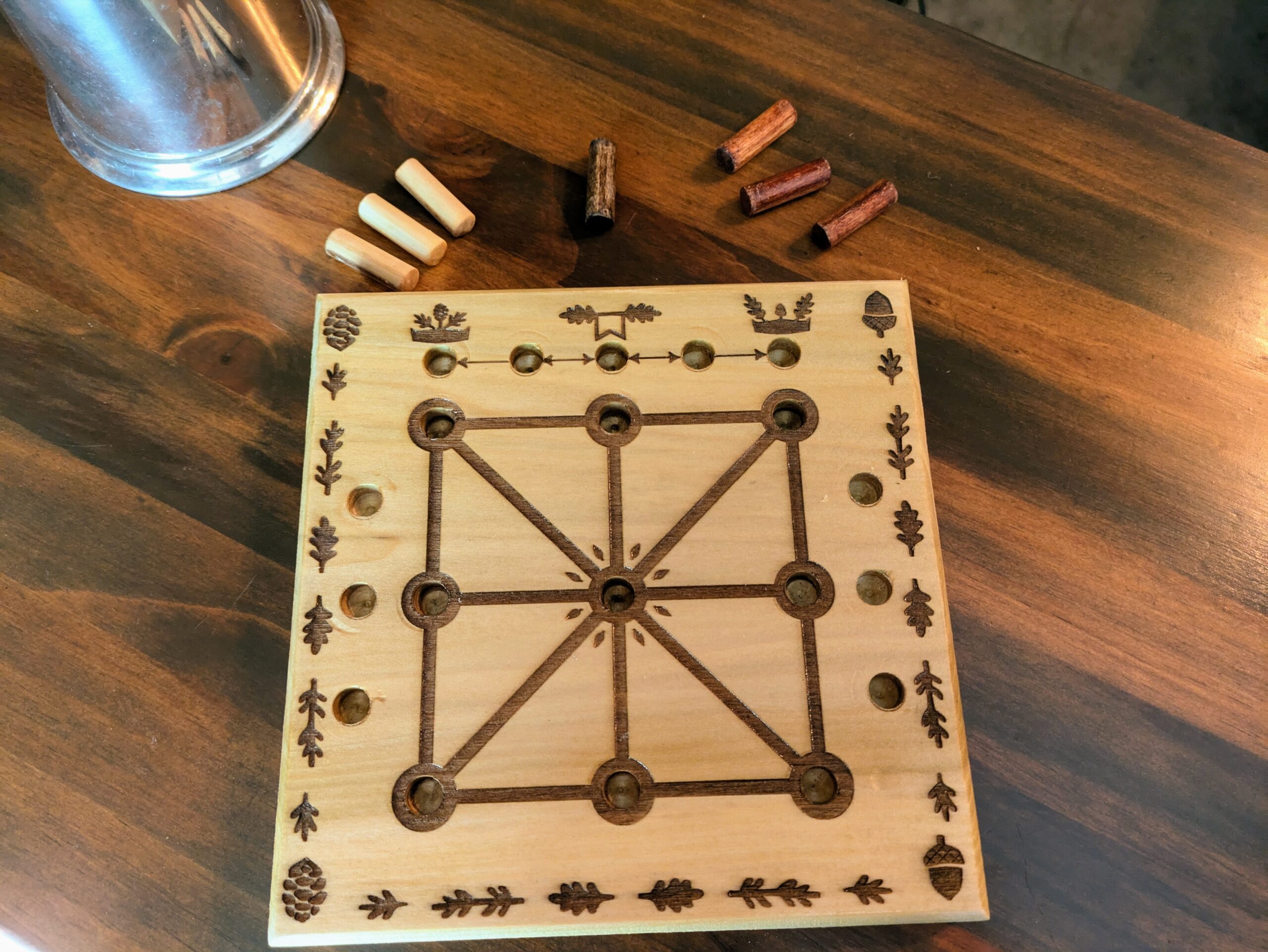
1. The first player can’t take the center. Opening in the center is strong enough to give player one a real edge, especially once someone in the family gets good. Taking that opening off the table keeps rounds balanced. On my boards, a sunburst marks the center space so nobody has to remember which square it was.
2. Play multiple rounds and track the score. A single two-minute round isn’t a satisfying unit of competition — a race to five is. My boards include a victory tracker built into the design: a five-dot line with a banner at the center and a crown at either end. You start at the banner and move your marker one dot toward your crown each time you win a round. Reach your crown and you’ve won the match. Best of three matches makes a great evening.
3. Alternate who goes first each round. Simple, but it matters. Swapping the first move every round keeps things fair over a series and stops “you went first” from becoming the excuse for every loss.
A version made to live on your coffee table
The best family board game is the one that’s already out of the box.
That’s the reason I make a handcrafted wooden Three Men’s Morris set at Herb & Howl Games. It’s built to sit out in the open — a nature-themed wooden board with the sunburst center and victory tracker worked right into the design, finished so it looks like something you’d choose to display rather than something you’d hide in a closet. It works as a coffee table object first, which means it’s always within reach when a kid wanders over and asks if you want to play.
That accessibility matters more than people expect. A game that lives on a shelf in the basement gets played four times a year. A game that lives on the coffee table gets played four times a week. The rules of Three Men’s Morris were designed to be scratched into stone and played anywhere — it feels right to keep it out where it can actually be used.
If you’d like one, you can pick up a board in my online shop or find it on Etsy. Each one is made in small batches, and it makes a genuinely good gift for a family with young children — or for anyone who likes a beautiful object that happens to do something.
Teach it to a four-year-old. Then wait about six months and see if you can still beat them.